By invitation · Now onboarding

The cloud that
speaks birr.

Global infrastructure, built for Ethiopians wherever they are. Bring your frontend, backend and databases together — connected deployments, shared workspaces and support in one dashboard. Pay in birr, or in dollars. No Dockerfiles, no foreign card, no lock-in.

A Starter app and a Dev database, free for 7 days. No card — after your invitation is approved.

Built by developers, for developers · birr or USD · no lock-in

Our partners

Trusted partners. Moving forward together.

In partnership with VetnovaExplore Vetnova (opens in a new tab)
0

Servers to manage.
No YAML, no Dockerfiles.

10

Managed services,
one dashboard, one bill.

~1min

From git push
to a live URL.

2

Ways to pay. Birr or USD —
whichever you hold.

Developer-friendly

Built by developers,
for developers.

Everything you'd expect from the platforms you already use — kept, not compromised. Just priced for you.

$ git push origin main

The push is the deploy

No servers, no YAML, no pipelines to write. Push, and it's already building.

● Node.js detected → Nixpacks

Zero configuration

Your framework is detected and built. A Dockerfile is optional — never required.

$ # nothing to install

Nothing to install

No CLI, no SDK, no plugin. Your editor already connects the way it connects to GitHub.

DATABASE_URL •••••••• ✓ saved

Environment, handled

Edit in place, paste a whole .env, generate a secret — one Save Changes, one redeploy.

✦ myshop-pr14.talaricloud.com

Every pull request, live

A preview URL posted on each PR. Your team reviews running code, not screenshots.

rollback → a3f21c9 ✓

Undo in one click

Roll back to any previous version instantly, with logs streaming live while you do.

If it works on Heroku or a DigitalOcean droplet, it works here — unchanged.

How it works

Three steps. No servers.

Connect a repository once. From then on, every push is a deploy — built, released and checked automatically.

  1. 1

    Connect

    Sign in, pick a GitHub repository. We detect the language and framework — nothing to configure.

  2. 2

    Push

    Every git push builds an image, stores it, runs your checks and releases it.

  3. 3

    Live

    A URL with SSL, streaming logs, live metrics and one-click rollback — after its build and health checks pass.

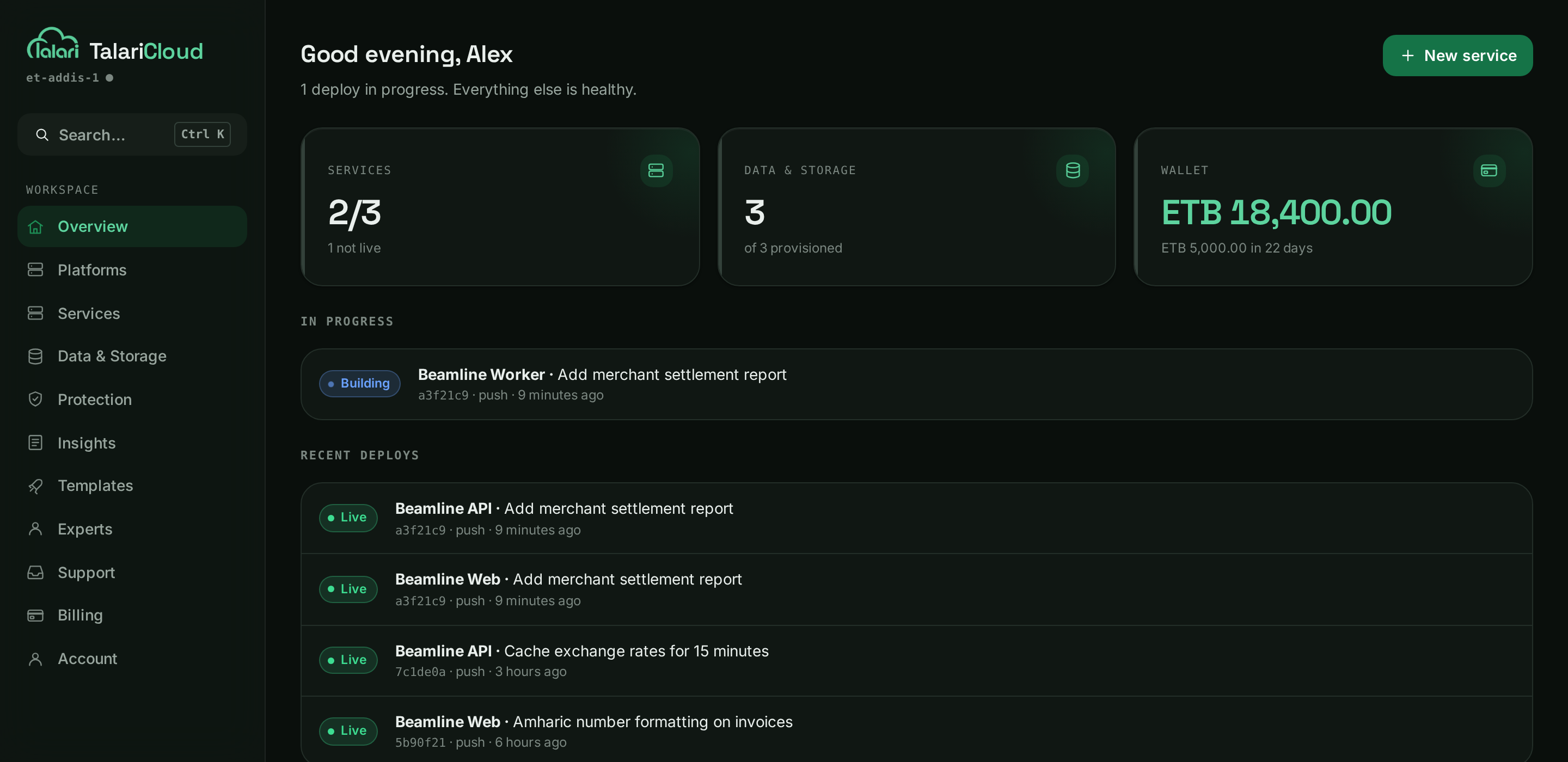
The TalariCloud dashboard: three services for one application, a deploy
             in progress, recent deploys and the wallet balance in birr.
Your workspace the moment a push lands.
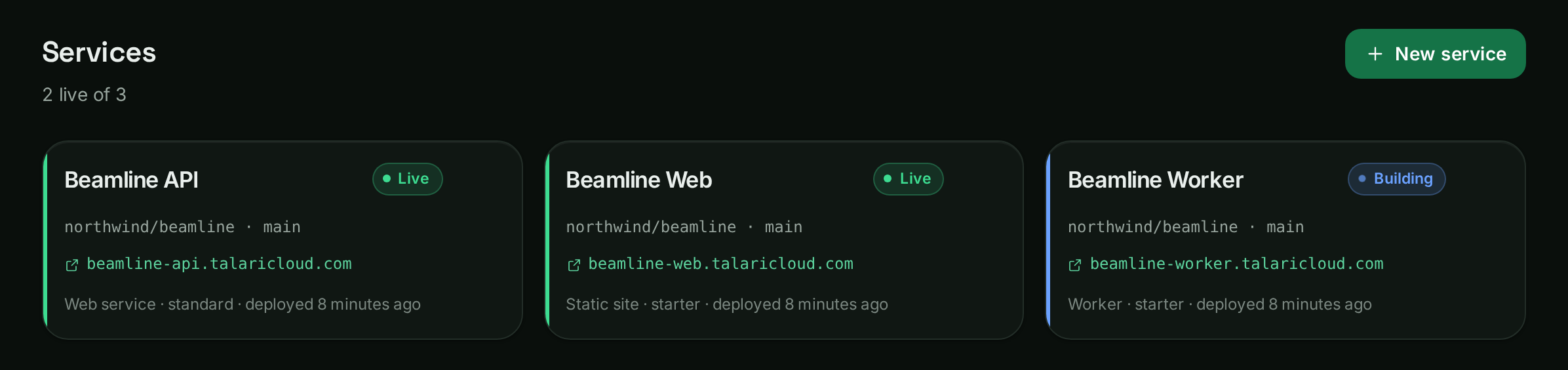
One application, every part of it. A frontend, a backend and a worker out of one repository — deployed together, on one bill.
The Services page: Beamline API, Beamline Web and Beamline Worker, all
             from minacgroup/beamline on main — two live and one building.
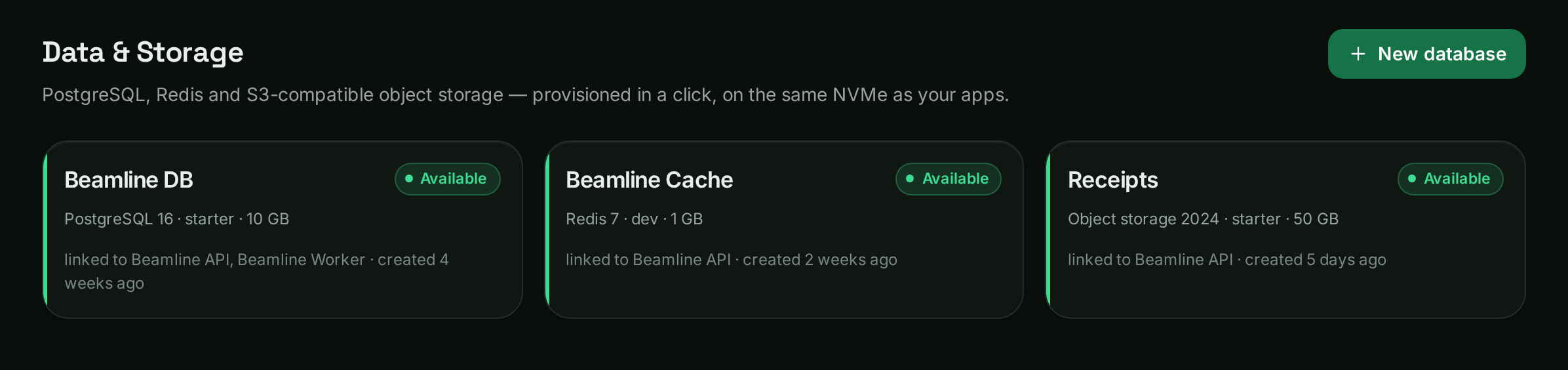
Data that wires itself. Postgres, Redis and object storage, each showing the services already connected to it.
Data and Storage: a PostgreSQL database, a Redis cache and an object
             storage bucket, each listing the services linked to it.

The platform

Everything between git push and production

Deploys that explain themselves

Every push builds, ships and releases automatically — with a live timeline and streaming logs for every stage. Something broke? Roll back to any previous version in one click.

No Dockerfile? No problem

We detect your framework and build it — Node, Python, Go, PHP, Ruby, Java, Rust, static sites. Bring a Dockerfile and we use yours instead.

Data & storage, one click

Managed PostgreSQL, Redis, S3-compatible object storage and a message queue. Link one to your app and the credentials appear in its environment — nothing copied by hand.

Every pull request, running live

Each PR gets its own temporary URL, posted right on the pull request. Your team reviews real running code — not screenshots.

Environment, the way you know it

Edit variables in place, paste a whole .env, generate a secret, reveal on demand. Save once — it redeploys once. Encrypted at rest, every reveal audited.

Your domain, your SSL

On paid Starter and higher plans, point myshop.com at us and verify. Certificates issue and renew themselves — and every app gets a talaricloud.com address free.

Logs and metrics, live

Streaming build and runtime logs, plus CPU and memory for every service — so you see what your app is doing, not guess.

Pause, don't lose

Run out of balance and your app pauses — it's never deleted. Top up and it's back where it was, disks and data intact.

Build. Operate. Grow.

Your whole application.
Your whole team.

From the first deployment to daily operations, keep your services, data, people and support connected.

Frontend, backend and database, connected

Deploy a complete application from one recorded commit. A blueprint connects declared services, supplies frontend API URLs during builds and keeps database credentials on the backend. Review configuration and capacity before starting; follow database readiness, migrations and component health through release.

A workspace for your team

Invite owners, developers and viewers with defined permissions. Organize application settings and encrypted variables by scope, with an audit trail for sensitive changes.

Backups and recovery

Configure backup policies, inspect available backups and restore into a separate database copy. Review the result before switching an application to restored data.

Review changes before release

Use configured pull-request previews, deployment preflight and reusable templates. Inspect the planned commands, missing values and connected components before queuing a release.

Understand usage and spending

Inspect service resource usage, plan costs and spending insights. Set budgets and see the operational information you need before expanding an application.

Every address, one application

Connect multiple custom hostnames, including your root domain and www address. Follow separate ownership, routing and HTTPS checks for each address.

Capacity and platform analytics

TalariCloud operators can review customer activity, wallet charges and top-ups, CPU, RAM, storage headroom, API latency and deployment outcomes. Capacity scenarios help plan growth; missing measurements stay clearly identified.

Operator access required. Capacity estimates are not dedicated-resource or uptime guarantees.

Help stays with the conversation

Support with the full picture.

One support chat for questions and payment evidence

Discuss a deployment issue, explain a billing question or submit evidence of a bank transfer in your support conversation. Attach PNG or JPEG pictures and PDF documents, and keep the replies and evidence together.

Submitting a receipt does not automatically credit your wallet. Payment evidence is reviewed.

Open support chat →

Hands-on operator assistance

Authorized operators can use recorded support sessions to investigate account issues and perform permitted project actions. Session history and audit records make that assistance traceable.

The TalariCloud expert program

Build with experience.
Grow your own reputation.

Invite an approved expert to help with your application, or apply to work with TalariCloud clients. Public application requests are open; account access remains invitation-only.

Find the right specialist

Explore approved, listed profiles by specialties, languages and availability. Invite an expert to a specific project with the access role you choose.

A record of completed work

Expert profiles include lifetime completed-project counts and client ratings. Public project titles are shared only with the client's permission.

You control project access

Certification does not grant account access. Experts accept project invitations; clients control access and confirm completion before leaving a review.

Talari Mail

Your company's name
on your company's email.

A business that sells from a free webmail address is quietly asking to be doubted. you@yourcompany.com is the cheapest credibility there is — and on TalariCloud it is set up and paid for from the dashboard you already have open, in birr, with no separate vendor and no separate bill.

Your domain, your addresses

Add the domain you already own. We hand you the DNS records to paste at your registrar and watch until each one verifies — ownership, then sending, then mail routing. Once it is green, create the addresses your business actually uses.

Open it in one click, or sign in

The account owner opens any mailbox from TalariCloud without another password. Staff who do not have a TalariCloud account sign in to Woyra Mail with their address and the password you hand them — and you can issue a new one the day somebody leaves.

The whole team, from one console

Create mailboxes for staff as you hire. Point sales@ and support@ at whoever should answer today, and change it tomorrow without telling a customer a new address.

One bill, in the currency you hold

Email is charged to the same wallet as your apps and databases, on the same monthly period, in birr or USD. No second invoice, no foreign card, no separate renewal date to remember — and no service quietly expiring because an invoice went to someone who left.

Read and send in Woyra Mail

Your staff read and write in Woyra Mail, a fast, modern web mail client. Pause a mailbox and nothing in it is lost; resume it and it carries on.

Talari Mail in full →

The catalog

One platform. Ten services.

Each one is picked from the dashboard, created in a click, and billed monthly in birr from the same wallet — no separate accounts, no new bills.

Talari DeployLive

Push to Git — we build, release and roll back, automatically.

Talari DataLive

Managed PostgreSQL & Redis, linked into your app in a click.

Talari StorageLive

S3-compatible object storage for files, uploads and backups.

Talari EdgeLive

Compression and caching at the ingress, in front of every service you run.

Talari FunctionsLive

Write just a handler; we wrap it and serve it at a URL.

Talari QueueLive

A managed message broker for background jobs and events.

Talari GuardLive

Per-IP rate limiting to absorb abuse, plus encrypted secrets.

Talari MonitorLive

Live CPU, memory and logs for every service you run.

Talari CILive

Run your tests on each push — a failure blocks the release.

Talari MailLive

Business email on your own domain — you@yourcompany.com instead of a free address. Add your domain, create mailboxes for your staff and pay from the same wallet; read and send in Woyra Mail, a modern web mail client.

Supported stacks

Bring what you already write.

The platform detects supported stacks and uses your declared configuration when your application needs it. Anything it doesn't recognise runs from a Dockerfile — so there is nothing it can't host.

Languages auto-detected

Node.jsPythonGoRubyPHPJavaRust

Frameworks anything on those

Next.jsExpressNestJSNuxtRemix DjangoFlaskFastAPIRailsLaravel SymfonySpring BootGinEcho

Static sites served by nginx

React / ViteVueSvelteAstroHugoJekyllPlain HTML

Service shapes not just websites

Web servicesStatic sitesBackground workersCron jobsFunctions

The escape hatch

.NET, Elixir, Deno, Bun, C++ — anything not on the list: add a Dockerfile and TalariCloud builds and runs that instead. Same push, same URL, same bill.

FROM node:22-alpine
WORKDIR /app
COPY . .
RUN npm ci --omit=dev
CMD ["node","server.js"]

Coming from somewhere else

You're already hosted
somewhere. We know.

Almost every app that arrives here comes from one of these. The first three groups move as they are — connect the repo, restore the dump, change a URL. The fourth is a server you have been patching yourself. What doesn't move is spelled out underneath, because reading it here beats discovering it halfway through a migration.

Push-to-deploy hosts same shape, same app

HerokuRenderRailwayFly.io KoyebNorthflankQoveryZeabur Clever CloudScalingoPlatform.shAptible SevallaDigitalOcean App PlatformAWS App Runner Elastic BeanstalkGoogle App EngineCloud Run Azure App Service

Managed data restore the dump, change the URL

Supabase PostgresNeonAivenElephantSQL Heroku PostgresAmazon RDS for PostgreSQL Azure Database for PostgreSQLCloud SQL for PostgreSQL UpstashRedis CloudCloudAMQP Amazon S3Cloudflare R2Backblaze B2

Front-end hosts static, or Node that renders

VercelNetlifyCloudflare PagesGitHub Pages GitLab PagesFirebase HostingAWS Amplify Hosting Render StaticSurge

Servers you patch yourself the Sunday-evening ones

DigitalOcean dropletsLinodeVultrHetzner ContaboOVHLightsailbare EC2 cPanel shared hostingHostingerNamecheapGoDaddy

What doesn't move

  • A vendor's SDK. Supabase Auth and Realtime, Firebase Auth and Firestore, Appwrite, Nhost, Pocketbase — the PostgreSQL underneath comes across intact, the client library does not. That code gets rewritten against your own database. It is the one migration here that costs real days.
  • MySQL and MongoDB. We run PostgreSQL and Redis. An app on PlanetScale, RDS for MySQL or MongoDB Atlas can move; its data needs converting first, and we will tell you that before you start rather than after.
  • Edge runtimes. Vercel and Netlify edge functions, Cloudflare Workers and Next.js ISR run on isolates spread across a hundred locations. Talari Functions are ordinary Node and Python handlers in one place — right for an API, not the same thing.

Why TalariCloud

Built for Ethiopians.
Wherever you are.

Global infrastructure, and a platform that finally assumes you might be paid in birr — in Addis, in the diaspora, or building for an Ethiopian audience from anywhere.

Birr

Top up with Telebirr or Chapa and deploy. No foreign card, no bank approvals, no waiting on someone else's payment rails to accept you.

or USD

Paid in dollars, or billing a company abroad? Pay that way instead. The currency is your choice, not a condition of signing up.

Global

Your app is reachable from anywhere, and so are you. Deploy from Addis, London, Dubai or Washington — it is the same dashboard and the same push.

0 lock-in

Ordinary containers, ordinary PostgreSQL, your Dockerfile if you have one. Nothing here is a dialect you would have to unlearn to leave.

Pricing

Plain plans, a month at a time

Start free for 7 days — Starter and a Dev database, no card. That is a real app and a real database, which is enough to find out whether this works for you. After that each application is charged a month in advance from your wallet — one plan for the whole thing. Your frontend, API and workers are one service on one bill, sharing the plan's compute between them, and a static frontend is included free. Change the plan any time; upgrades are quoted before they are charged. Delete an application, stop paying. Run out of balance and your app pauses — never deleted.

We quote prices on request, in birr or USD, against what you actually intend to run. Ask and you will have a written figure the same day — no call, no discovery process.

Starter

512 MB · ½ CPU
  • Free for your first 7 days
  • Frontend, API and workers on one plan
  • Auto-deploy from GitHub
  • talaricloud.com subdomain + SSL
  • Custom domains on paid plans
  • Live logs & one-click rollback
Try free for 7 days

Standard

1 GB · 1 CPU
  • Custom domains
  • PR preview deploys
Request an invite

Max

4 GB · 4 CPUs
  • Room for JVM, ML and hungry monoliths
  • Priority support
Request an invite

Enterprise

8 GB · 8 CPUs
  • For a busy JVM service or real inference
  • Priority support
Request an invite

Custom

Let's talk

More memory than Enterprise? Machines of your own? An invoice instead of a wallet, or terms in writing?

Tell us what you need. We will say plainly what we can do today — and what we cannot do yet.

Contact us

Managed data

PostgreSQL, Redis, object storage and queues. Storage is included in the plan — no per-gigabyte surprise at the end of the month.

Plan Memory Storage
Dev Side projects, staging, and anything still being built — ✦ free for your first 7 days 256 MB 5 GB
Starter A small production app with real users 1 GB 10 GB
Standard Growing traffic, or a dataset that no longer fits in memory 4 GB 50 GB
Pro Heavy reads, large datasets, reporting workloads 8 GB 100 GB

Every service runs one instance, and deploys swap it without dropping a request — need more room, move up a plan. · Daily automated backups on every plan, kept 14 days. Databases run as a single instance — your data is replicated across nodes, but a node failure means a short restart, not a silent failover. · billed in birr or USD, your choice · quotes exclude VAT

Tell us what you intend to run — one app, a database, a team of six — and we will send the monthly figure in writing, in birr or USD.

Ask for a price

FAQ

You'll ask. We answered.

What can I host?

Anything that runs on Linux and listens on a port: websites, APIs, mobile-app backends, admin panels, bots, cron jobs, static sites. If it runs on Heroku, Render, Railway, Fly.io, Vercel, Netlify, App Engine, Azure App Service or a DigitalOcean droplet, it runs here unchanged, and PostgreSQL or Redis moves with a dump and a changed URL — from Supabase, Neon, Aiven, Upstash or RDS. The exception is a vendor's SDK: Supabase Auth, Firebase and the like get rewritten against your own database. The full list, and what doesn't move, is above.

Which frameworks are supported?

Node, Python, Go, Ruby, PHP, Java and Rust are detected automatically — so Next.js, Django, Rails, Laravel, Spring Boot and friends just work. Static sites too. Anything else runs from a Dockerfile.

Do I need to know Docker?

No. Push ordinary code and the platform figures out the rest. If you already have a Dockerfile, we respect it.

Is there a CLI or IDE plugin?

Not yet — and you don't need one to deploy: git push is the deploy, so your editor already connects the way it connects to GitHub. A CLI for logs and environment variables is on the roadmap.

Which database plan do I need?

Start on Dev. It is a real PostgreSQL or Redis instance with 256 MB of memory and 5 GB of storage — enough for a side project, a staging environment, or a small production app with real users, and free for your first seven days. Every plan includes its storage and a daily backup kept for 14 days, and you can download a full dump at any time. The plan is chosen when you create the database — changing it in place is not built yet, so moving up today means creating the bigger one and loading your dump into it.

What does it cost?

We quote on request rather than publishing a list. Tell us what you intend to run — one app, an app with a database, a team of six with email — and you will have the monthly figure in writing the same day, in birr or USD, with nothing hidden in it. Plans are prepaid a month at a time, there is no card on file and no contract, and your first seven days on Starter with a Dev database are free, so you can watch the platform work before any figure matters.

How do I pay — birr or dollars?

Either. Top up in birr with Telebirr, Chapa or a verified CBE bank deposit, or top up in USD by card or PayPal. Birr and USD wallets are kept separate, so what you hold is what you spend. Each application is charged a month at a time from your balance — frontend, API and workers on one plan, static sites included free — no card on file, no surprise bill at month's end, and nothing goes into debt. If the balance will not cover a renewal we tell you three days ahead; if it still does not, your app pauses. It is never deleted.

I'm outside Ethiopia. Can I use it?

Yes. TalariCloud runs on global infrastructure and serves users wherever they are. It's built for Ethiopian developers and teams — in Addis, in the diaspora, and anyone building for an Ethiopian audience — but nothing about it requires you to be in one place.

I'm on Heroku / DigitalOcean / shared hosting. How hard is switching?

An afternoon, usually. Connect the repo, paste your environment variables (a whole .env pastes in one go), import the database, flip your DNS. Your old host can keep running while you validate the new deployment and plan your DNS cutover. Our engineers do the migration with you, free.

Who's behind TalariCloud?

TalariCloud is built by Ethiopian developers — we wanted a platform like this to deploy on, so we built it.

Ready to ship?
You're one push away.

Access is by invitation. Request access; an operator will review it and send your private onboarding link if approved.

Request invite · 7 days free

By invitation

Start your free 7 days

TalariCloud account creation and use are invitation-only. Tell us your email and what you are building. An operator reviews your request and, if approved, sends a private invitation link with onboarding instructions.

No spam. One email when your invite is ready.